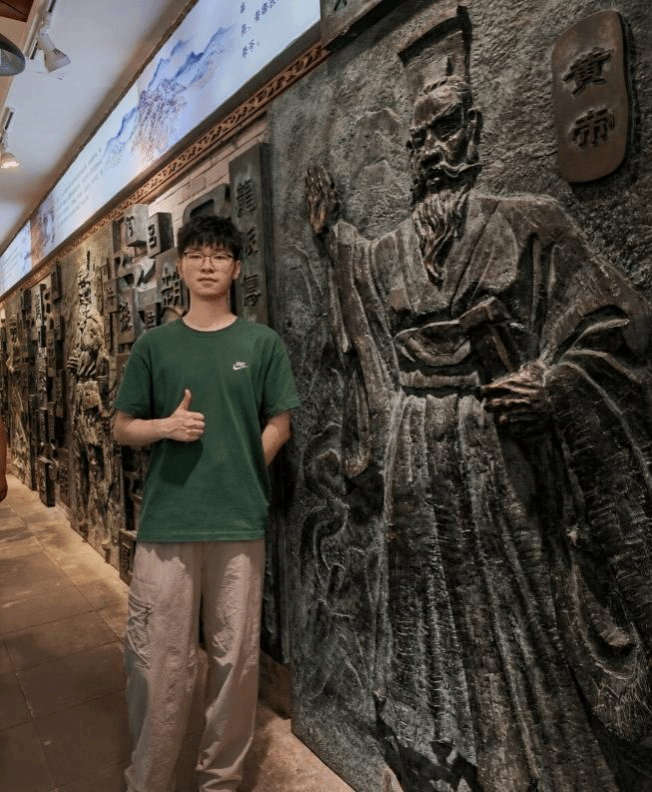
Wu Yuhao is a 2023-level master's student in Mechanical Engineering at the Smart Sensing and Sustainable Diagnosis and Prognostics Lab (S3DP-Lab), College of Engineering. Under the meticulous supervision of Associate Professor Chen Peng, he has published a total of 9 academic papers. As first author or co-first author, he has published 5 SCI papers in JCR and Chinese Academy of Sciences Category 1 and Category 2 Top journals, including 2 Category 1 papers and 3 Category 2 papers, appearing in Mechanical Systems and Signal Processing, Ocean Engineering, IEEE Transactions on Instrumentation and Measurement, IEEE Transactions on Reliability, and Journal of Sound and Vibration. In addition, he has published 2 EI conference papers and, as the first student inventor, has been granted 1 national invention patent. He has received numerous honors including the National Scholarship for Graduate Students and the university First-Class Scholarship. He will soon join the Central Research Institute of Zoomlion Heavy Industry, working on intelligent diagnosis and health management for high-end engineering equipment.
The Interdisciplinary Journey Begins
From the World of Code to Fault Diagnosis
I graduated with a bachelor's degree in Computer Science and Technology and transitioned across disciplines into the field of Mechanical Engineering. When I first entered the fault diagnosis domain, I found myself deeply challenged by the complex mechanisms of mechanical systems and the diverse characteristics of industrial signals. However, under the attentive guidance of Associate Professor Chen Peng, I gradually found my direction in scientific research. Rather than rushing me into specific projects, my supervisor systematically guided me through the fundamentals of vibration theory, signal processing methods, and seminal literature in the field, helping me build a complete knowledge framework and cultivate the ability to identify and formulate scientific problems from industrial data. When I was writing my first SCI paper, Professor Chen patiently helped me refine the logical structure and polish the academic expression, telling me: "Good research is not just about doing it well, but also about telling a compelling story." Through continuous learning and practice, I gradually integrated the programming skills and algorithmic thinking acquired during my undergraduate computer science studies with mechanical engineering knowledge, transforming from a "novice" in fault diagnosis to someone capable of independently conducting algorithm optimization and core technology development. My interdisciplinary background not only broadened my research perspective but also taught me to analyze and solve complex engineering problems from more diverse angles, which has become the most valuable asset in my research growth journey.
Sharpening Skills Through Practice
Bringing Research Achievements to Industrial Sites
"Research cannot remain at the theoretical level; it must effectively solve real problems on industrial sites." This is a principle that Professor Chen Peng frequently emphasizes, and it has profoundly influenced my research philosophy. Our research group not only possesses a mechanical component fault prediction and simulation experimental platform but has also collected real operational data from large-scale industrial equipment such as wind turbine gearboxes, train bogies, port cranes, and multi-cylinder hydraulic pumps, equipped with various types of industrial sensing devices including high-precision accelerometers, acoustic emission sensors, and pressure sensors. The open and comprehensive research platform and abundant data resources provide a solid foundation for students to conduct innovative research. During my graduate studies, under my supervisor's guidance, I participated in multiple research projects, including the National Natural Science Foundation, the AVIC Key Research and Development Project (sub-project), the Guangdong Basic and Applied Basic Research Foundation, and commissioned projects from the Guangdong Institute of Special Equipment Inspection and Research. I have consistently adhered to conducting research based on actual engineering data. From laboratory validation to industrial site applications, from theoretical model construction to engineering problem solving, every achievement has been made possible by the team's strong research support, as well as my supervisor's cultivation of and trust in students' independent innovation capabilities. It is through repeated engagements with real-world engineering problems that I have come to more profoundly understand the value and significance of research serving practical industries.
Building Dreams Together
Growing Together in a Warm and Supportive Team
The path of scientific research has never been a solitary endeavor. Over the three years in our research group, my deepest feeling is that this is not just a place for doing research, but a warm collective where like-minded individuals engage in open exchange and advance together. Whether regarding further studies or career placement, Professor Chen is our most trusted mentor. He is rigorous, pragmatic, and highly responsible, organizing weekly group meetings and providing patient and detailed guidance on everything from foundational issues like setting up research environments to academic challenges like algorithm optimization. During phases when research progress stalled and results remained elusive, he often took the initiative to communicate with us, sharing his own research experiences to help us adjust our mindset, strengthen our confidence, and clarify our direction.
At the same time, I am deeply grateful to the senior colleagues, fellow students, and junior members who have accompanied me along this journey. Those days of dedication spent between the laboratory, the cafeteria, and the dormitory have become especially memorable because of the companionship we shared. We went through the intense process of major paper revisions together, faced the setbacks of experimental failures together, and celebrated breakthroughs together. Everyone openly exchanged research experiences and shared writing insights, growing together through mutual support. This bond of shared struggle and solidarity has become one of the most treasured gains of my graduate studies.
About S3DP-Lab
The S3DP-Lab was established by Associate Professor Chen Peng. In response to major national strategic needs such as "Industry 4.0," "Intelligent Manufacturing," and the autonomous control of high-end equipment, the lab has long been committed to cutting-edge research in industrial equipment intelligent sensing, fault diagnosis, and health management. The team conducts systematic research in areas including intelligent acoustics and multimodal signal processing, machine vision and advanced sensing, trustworthy multimodal AI and collaborative computing, embodied intelligence for industrial servo robots, and inspection and diagnosis of new energy lithium batteries and key equipment. Its research targets encompass aviation electromechanical power systems, intelligent transportation (such as high-speed trains), wind power transmission systems, and industrial robots, forming distinctive disciplinary features and research advantages. Team leader Associate Professor Chen Peng has been selected for Shantou University's "Outstanding Talent Program" and recognized as a High-Level Talent of Shantou City. He has led over 10 research projects including the National Natural Science Foundation, the AVIC Key Research and Development Project (sub-project), the Guangdong Basic and Applied Basic Research Foundation, the Guangdong Science and Technology Plan Project, and enterprise-commissioned projects, and has participated in 6 national-level research tasks including the National Key Research and Development Program and key projects of the National Natural Science Foundation. In recent years, the team has published over 50 SCI papers in JCR Category 1 and Chinese Academy of Sciences Category 1 and Category 2 Top journals, including 2 highly cited and hot papers. Relevant results have appeared in high-level journals such as Mechanical Systems and Signal Processing, Expert Systems with Applications, IEEE Internet of Things Journal, IEEE Transactions on Instrumentation and Measurement, IEEE Transactions on Reliability, Ocean Engineering, and Journal of Sound and Vibration. The team has been granted 6 national invention patents, with research covering wind power equipment, rail transportation, port machinery, aerospace, and other fields.
Currently, the team comprises 1 associate professor and 15 master's students, and has built a research platform encompassing a mechanical component fault prediction and testing platform, multimodal industrial sensing systems, and a real operational database for large-scale industrial equipment. The team maintains long-term close collaboration with internationally renowned institutions such as the Karlsruhe Institute of Technology in Germany, KU Leuven in Belgium, the University of Sydney in Australia, the University of Alberta in Canada, and the University of Liverpool in the UK, as well as leading industry enterprises and research institutes. It has accumulated operational data resources from various types of major equipment, providing solid support for high-level research innovation and engineering application studies. The team adheres to the educational philosophy of "industry-oriented, rooted in engineering practice, and cultivating innovative talents," with a focus on the synergistic development of students' research capabilities, engineering practice skills, and innovative thinking. In recent years, many graduate students have received the National Scholarship as well as provincial and university-level honors. Graduates are widely employed at research institutes, high-end equipment manufacturing enterprises, and leading industry companies including AECC, iFLYTEK AI Research Institute, and Zoomlion Central Research Institute, or have pursued doctoral studies at universities such as Shandong University and Tongji University. Looking ahead, the team will continue to focus on major national needs and regional industrial development strategies, making positive contributions to the high-quality development of the high-end equipment manufacturing industry and the intelligent transformation of industry.