
About EIP-CDIO
China's current engineering education model was inherited from the Soviet specialized education system. This model has two major shortcomings that make it incompatible with the practical requirements of modern industry. First, it features specialized, targeted training that meets the demands of a planned economy. Second, the development of students' capabilities is disconnected from the needs of modern industry. Specialized, targeted training results in students having a narrow knowledge base, leaving graduates less competitive. Disciplinary education fails to fully develop students' autonomy, creativity, learning abilities, and adaptability. More importantly, there is a disconnect between disciplinary education and industrial practice. Students develop almost no teamwork skills, communication abilities, or multi-disciplinary, large‑system management capabilities—all of which are essential for survival and growth in modern industrial production.
The era of economic globalization and the knowledge‑based economy has arrived. How to respond to this development trend is a central concern for countries and sectors worldwide. The internationalization of Chinese engineering education is a response to economic globalization and an inevitable outcome of the process of world economic integration. The urgent task for China's higher engineering education is to cultivate Chinese engineers who can align with international standards as quickly as possible. However, many problems still exist in China's engineering education practice, such as emphasizing theory over practice, stressing individual academic ability while neglecting teamwork and collaboration, and focusing on knowledge acquisition while overlooking the cultivation of innovation and pioneering spirit. Comparing these practices with internationally accepted consensus on the requirements for engineers—such as those of Boeing, the U.S. engineering education accreditation system ABET EC2000, and the Canadian engineering education accreditation system CEAB—it is easy to see that China's engineering education notably lacks training in personal development skills, interpersonal communication skills, and system design capabilities. Yet these are precisely the qualities that a successful international company expects from a qualified engineer. A report released by the McKinsey Global Institute in October 2005 stated that, of the approximately 600,000 engineering and technical graduates in China in 2005, fewer than 10% were suitable for working in international companies. The report attributed this to the fact that "China's education system is heavily theoretical, and Chinese students receive almost no practical training in projects and teamwork, whereas European and North American students solve practical problems in teams." Therefore, we face a tremendous challenge. To meet the demands that future development will place on engineers, engineering education reform is essential, requiring a comprehensive and thorough overhaul of existing training programs.
In September 2005, Professor Gu Peihua joined Shantou University's College of Engineering as Dean, moving from the University of Calgary in Canada. Together with his colleagues at the College of Engineering, Professor Gu examined international and domestic engineering education concepts and practices. Ultimately, they selected CDIO (Conceive-Design-Implement-Operate) as the primary philosophy for their teaching reform. The reasons for selecting the CDIO educational philosophy are as follows:
This philosophy embodies the international consensus in contemporary engineering education, providing a solid foundation for our internationalization efforts.
The CDIO international organization has convened a large number of education experts to develop a comprehensive implementation framework, offering a robust theoretical and practical foundation for adopting this philosophy.
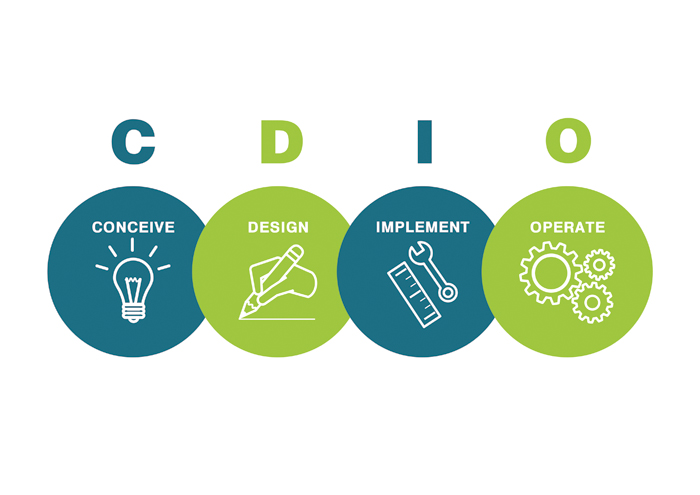
The CDIO international organization currently includes dozens of renowned universities worldwide. In early 2006, Shantou University's College of Engineering joined the organization, becoming the first member university from China. Our reform goal is to establish a curriculum system that aligns with the international consensus on engineering education by focusing on cultivating students' systematic engineering and technical capabilities—particularly their abilities in project conception, design, development, and implementation—as well as strong self‑learning, organizational, communication, and coordination skills, while absorbing world‑advanced engineering education concepts. Given the lack of emphasis on professionalism and professional ethics in China's education system, we decided to underscore the importance of professional ethics alongside the CDIO reform. Consequently, the College of Engineering at Shantou University proposed an entirely new EIP‑CDIO training model. EIP (Ethics, Integrity, Professionalism) refers to ethics, integrity, and professionalism. CDIO (Conceive-Design-Implement-Operate) represents conception, design, implementation, and operation. EIP‑CDIO is a new higher engineering education model that aims to cultivate advanced engineering professionals by organically integrating professional ethics and integrity with conception, design, implementation, and operation.