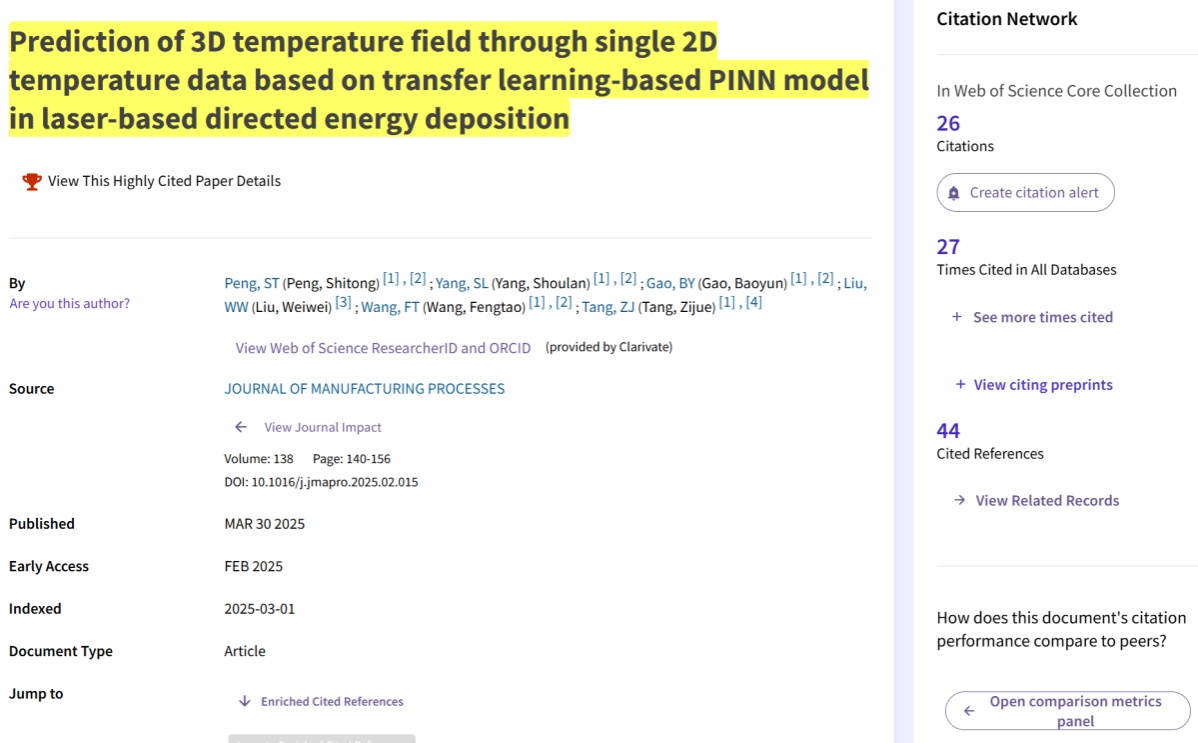
Associate Professor Peng Shitong from the IMAM Team of the Key Laboratory of Intelligent Manufacturing Technology (Ministry of Education), Shantou University, and Shantou Key Laboratory of Intelligent Operation, Maintenance and Remanufacturing Technology for High-end Equipment, has achieved new progress in the real-time prediction of temperature fields during laser metal additive manufacturing. Relevant findings were published as a research paper in the top journal Journal of Manufacturing Processes (CAS Zone 1, IF=6.8), and have recently been selected as an ESI Highly Cited Paper.
The temperature field is a key factor affecting the forming quality of metal additive manufacturing components, which is directly related to the deformation, microstructure evolution and final mechanical properties of metal parts. However, traditional temperature monitoring methods can usually only obtain two-dimensional surface temperature information, making it difficult to reflect the complex three-dimensional thermal behavior inside materials. On the other hand, reconstructing three-dimensional temperature fields through numerical simulation methods such as finite element and finite volume methods often suffers from high computational cost, long time consumption, and difficulty in meeting the requirements of online applications.
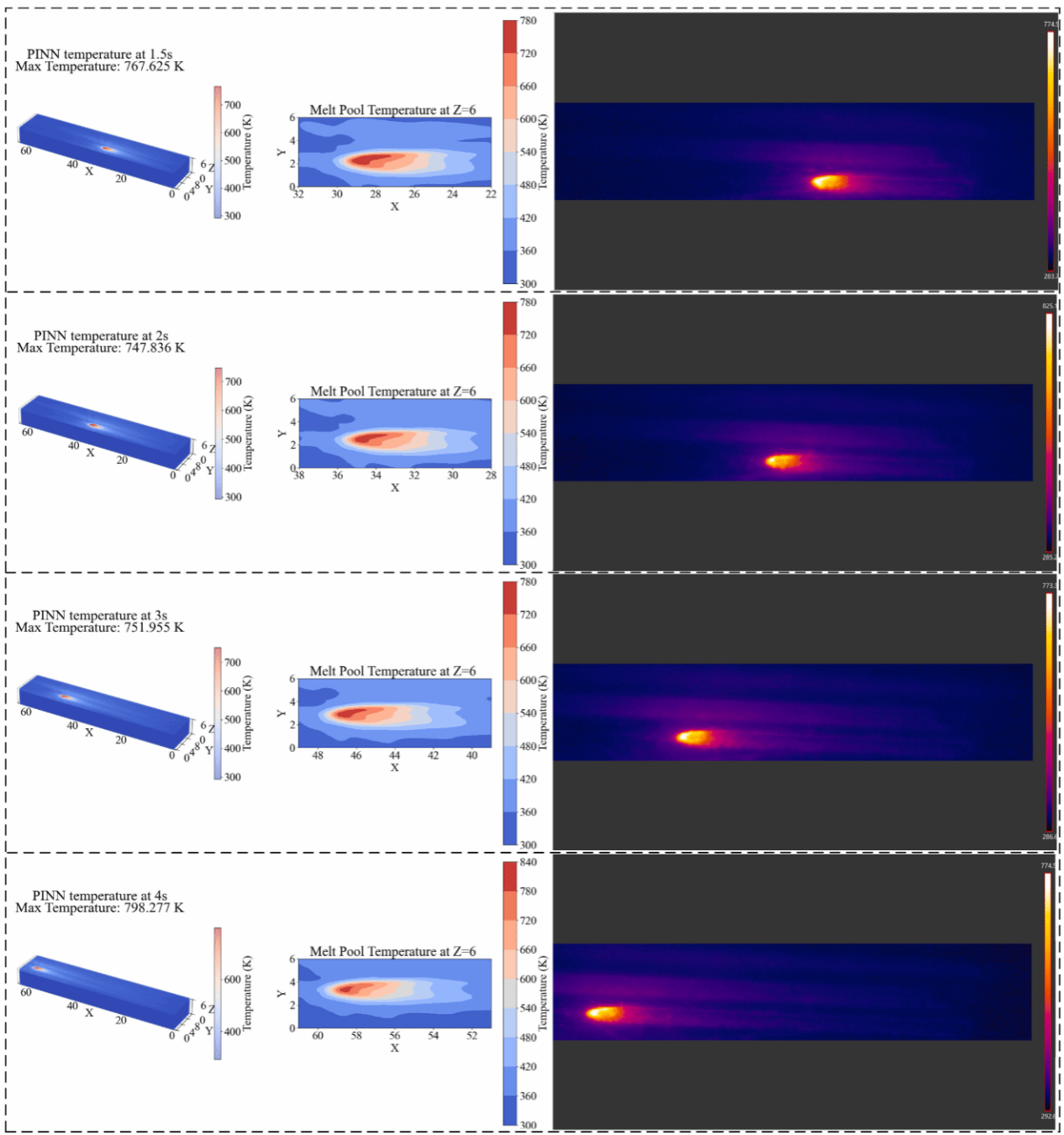
To address this bottleneck, the team combined physics-informed neural networks with transfer learning to construct a novel model framework that balances physical constraints, prediction accuracy and computational efficiency. By incorporating heat conduction, thermal radiation and convective heat transfer (often overlooked in the past) into a hybrid heat transfer partial differential equation, and integrating a lightweight attention module, residual connections and fully connected networks, the model was pre-trained with numerical simulation data and fine-tuned with two-dimensional infrared temperature experimental data. This finally realized efficient and accurate prediction of the three-dimensional temperature field during blue laser deposition from a single set of two-dimensional temperature data. The integrated scheme of "hybrid physical modeling + lightweight spatial-temporal feature extraction + transfer learning for cross-task knowledge transfer" not only enhanced the model’s ability to characterize complex thermal behaviors and internal temperature distributions, but also alleviated the scarcity of experimental data and high training costs.
This method shows significant advantages in both prediction accuracy and computational efficiency. The model’s average temperature prediction error is below 1.3%, maintaining high consistency with experimental results in most regions. Meanwhile, the transfer learning strategy significantly shortens the training time for target tasks and improves the stability and generalization ability of the model in predicting complex thermal processes. The study also demonstrates that this framework can not only reconstruct the full three-dimensional temperature distribution using two-dimensional experimental data, but also has the potential to be extended to other metal additive manufacturing processes.
The IMAM Team focuses on the national strategy of "Artificial Intelligence + Manufacturing", deeply integrating cutting-edge technologies such as multimodal large models, generative AI, digital twins and physics-informed neural networks. It conducts systematic research in four major directions: intelligent operation and maintenance and health management of high-end equipment, intelligent monitoring and quality control in additive manufacturing processes, laser additive remanufacturing processes and performance evaluation, and multiscale forming mechanisms and defect control. The team has made key breakthroughs in technologies including multimodal large model-driven equipment fault diagnosis and life prediction, real-time additive manufacturing defect recognition integrating retrieval-augmented generation and multimodal perception, AI-enabled collaborative evaluation of remanufacturing process-microstructure-performance, and multiphysics coupling defect suppression driven by graph neural networks and physics-constrained deep learning. It further explores industrial multimodal agent systems for equipment-process collaboration, establishing a full-chain intelligent technology system from manufacturing process monitoring to service health management, providing core support for the green, highly reliable and intelligent development of China’s high-end equipment.
Led by Professor Wang Fengtao, the team currently has 10 core researchers, including 2 professors, 3 associate professors and 5 lecturers, as well as more than 50 doctoral and master’s students. In recent years, the team has undertaken dozens of projects funded by the National Natural Science Foundation of China, Guangdong Natural Science Foundation and enterprise research cooperation projects. It has published more than 100 high-level academic papers in authoritative journals at home and abroad, such as Mechanical Systems and Signal Processing, Reliability Engineering & System Safety, Journal of Manufacturing Processes and Journal of Mechanical Engineering, and has been granted more than 50 invention patents.
The team is committed to building an important research base serving major national strategic needs and the industrial development of eastern Guangdong. It focuses on key generic technical issues and cutting-edge scientific problems in modern industries, strategic emerging industries, as well as the big health and medical device sectors. The team provides basic, strategic and forward-looking knowledge reserves, technical support and talent guarantees for the transformation, upgrading and long-term development of local high-end equipment, new energy (offshore wind power), new materials, high-performance medical devices and traditional characteristic industries (textiles and garments, creative toys).
Text & Photos: School of Engineering